
This post is also available in:
Eight years ago I wrote about installing photovoltaic solar panels on my garage roof: the start of what has since become a full solar battery storage system here in the Alps. It began as a DIY project with plug-and-play microinverters, each one sitting behind two panels, converting DC to AC and feeding straight into a domestic socket. At the time, plenty of people told me this was either impossible or dangerous. It wasn’t either of those things. I was doing it in France, where it was perfectly legal, and the Germans had been doing it for years.
What’s interesting is that the idea has come full circle. These “balcony power stations” are now one of the most popular ways for people to dip their toes into solar. And as I write this, largely thanks to the current situation in the Strait of Hormuz, the UK government is actively trying to update its electrical codes to allow exactly what I was doing in 2018.
The Original Install: a Learning Process
The original system worked well for several years. Then, one by one, the microinverters started to fail. The culprit was heat: a hot tin roof in an Alpine summer turned out to be a less than ideal environment for electronics. Something well known by experienced installers now. And in fact the manufacturers have updated the units to prevent this. It’s a risk though: if these microinverters fail you have to get up on the roof and remove the panels to get to them, and this can be a pain.
The Chinese supplier communicated well, right up until the point they realised I wasn’t asking about one failed unit, but all of them. At that point, they went quiet. Completely silent. That’s the cautionary tale: when you’re buying from a distant supplier with no local presence. The panels themselves still work. All of them. Panels are robust; it’s the electronics that can let you down.
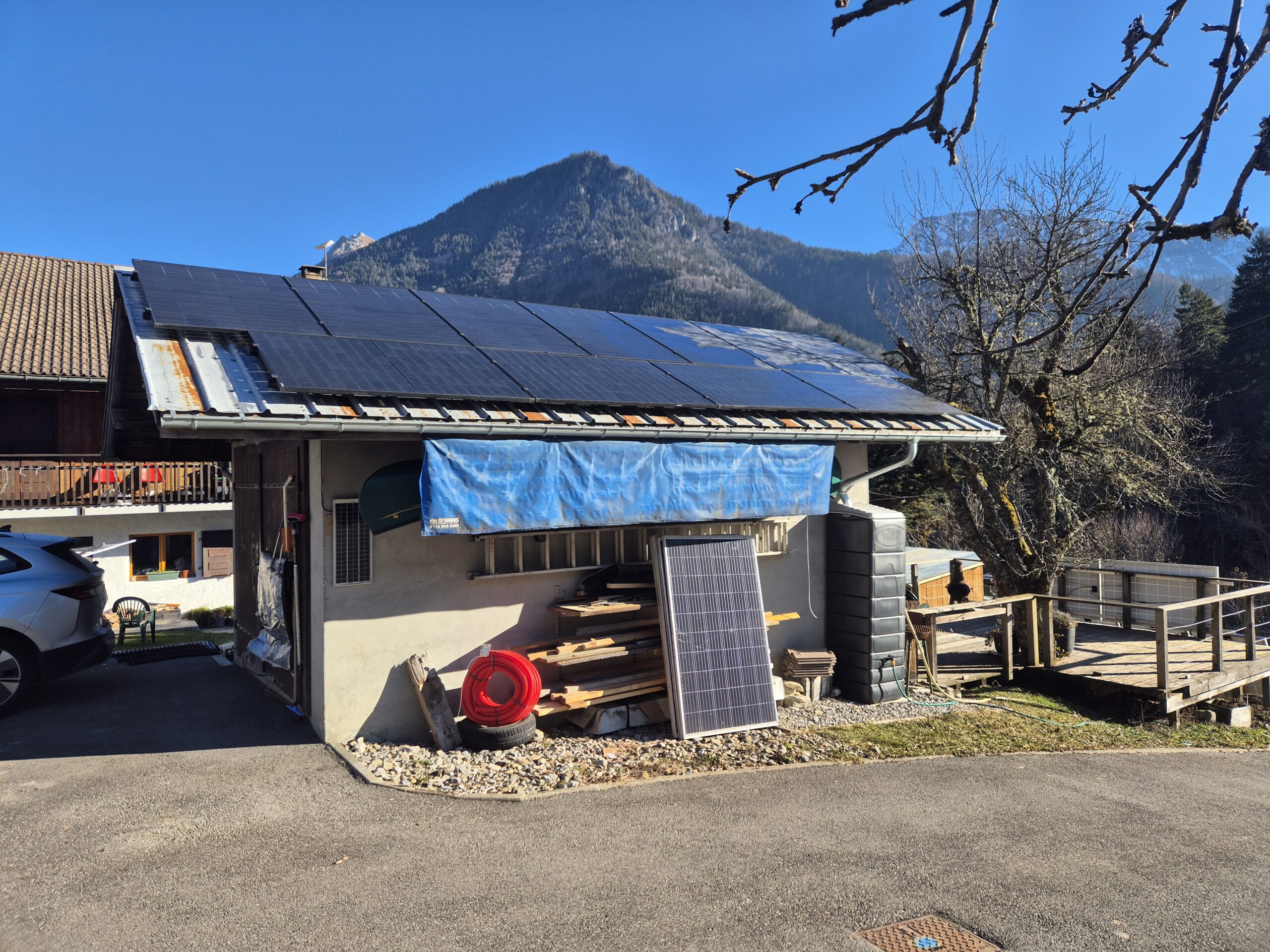
The new panels on my garage roof
Doing It Properly: Stage One, May 2025
So I decided to start again and this time use a professional installer. Three things to address this time:
- The 3-phase supply issue (mentioned in the original post): my house runs on 3-phase power, which makes self-consumption trickier to manage
- A proper inverter installation: accessible and in the cellar rather than on a hot roof
- Future-proofing for a battery
I used a local company, Leman Solar, who completed the upgrade in two days. The new panels are 440W each, compared to 270W for the old ones. Eleven panels again, but almost twice the output. Technology moves on.
The old panels? I couldn’t face sending them to recycling when they still work perfectly. I had space on my land, so they’ve been given a second life there. It felt like the right thing to do. Plus that is a project I can do myself and it’s easy to tap into the work Leman Solar have done. I did consult with them first!
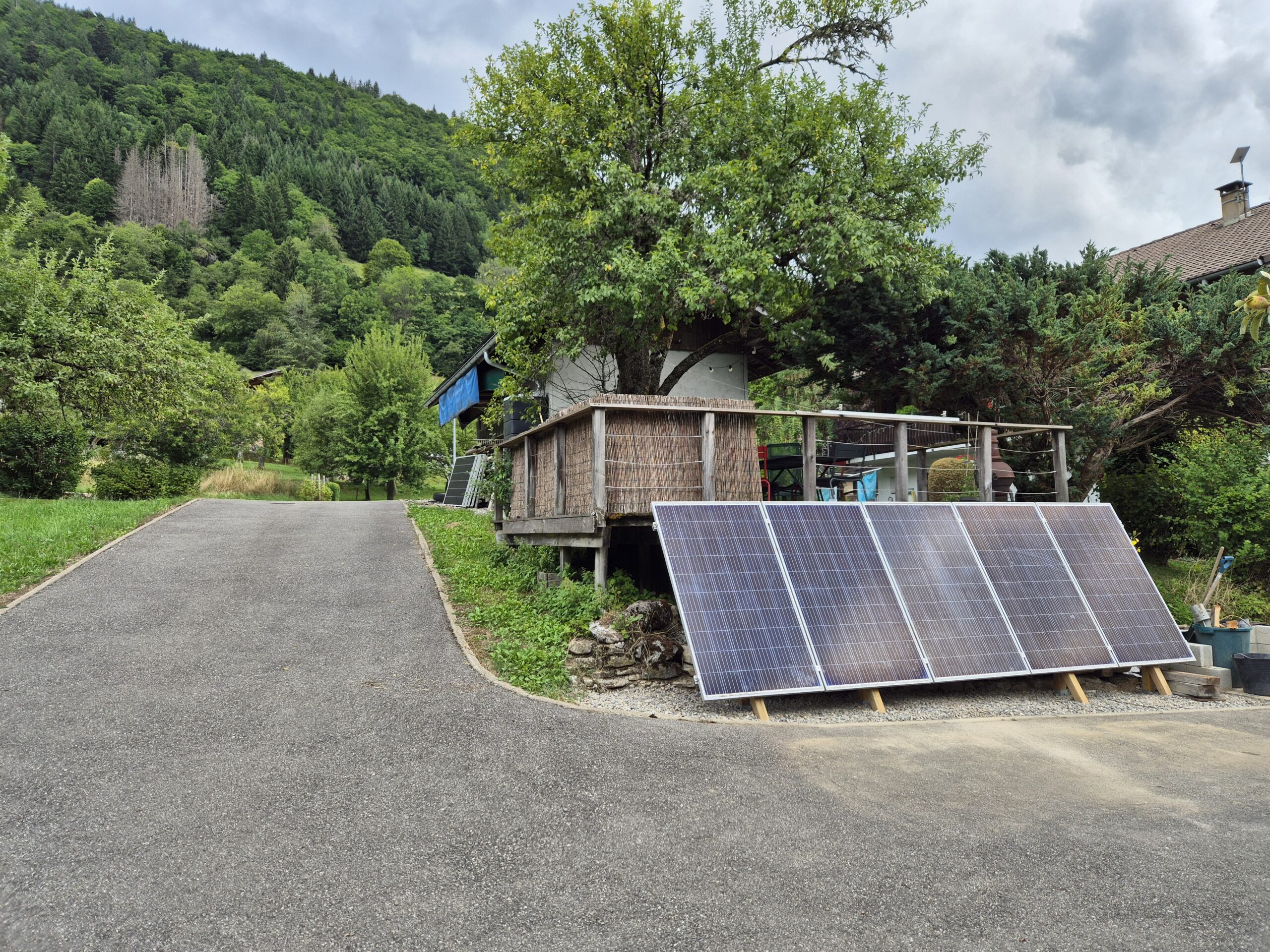
The old panels ground mounted by my parking
This time the system is app-connected, so I can see exactly what’s being produced, minute by minute, on my phone. It quickly became obvious that 11 x 440W produces far more power than I can use in a house, even charging the car. On a good day the car would be full by mid-afternoon and the surplus was simply going back to the grid. Free, for EDF, but not helping my ROI.
Stage Two: Adding Solar Battery Storage, November 2025
The install had been done with a battery in mind from the start, so six months later a 14 kWh battery went in. In summer the logic is simple: the panels fill the battery during the day, and the battery powers the house in the evening and overnight. Very little, and sometimes nothing, comes from the grid at all.
In winter there isn’t nearly enough sun to fill the battery from the panels alone, but a battery isn’t useless in winter. Mine runs “arbitrage”: charging on the off-peak overnight rate of around 13c/kWh and discharging during the day when power would otherwise cost 21c/kWh. The system is 95% efficient, so the net saving is around 7c per kWh cycled. Not spectacular, but it adds up day in day out.
The Numbers
| Jan | Feb | Mar | Apr | May | June | July | Aug | Sept | Oct | Nov | Dec | Year | |
|---|---|---|---|---|---|---|---|---|---|---|---|---|---|
| Before (€) | 571 | 446 | 386 | 264 | 257 | 195 | 180 | 181 | 186 | 269 | 371 | 582 | 3,888 |
| After (€) | 444 | 282 | 239 | 115 | 100 | 2,360* | |||||||
| Saving | 22% | 37% | 38% | 56% | 61% | 39% |
*Projected full year based on Jan to May
The trend is clear. January savings were 22%: modest, but the battery was already earning its keep on arbitrage alone. By May, we’re saving 61% month on month. As I write this, some days we take no power from the grid at all. The car is charging for free. We expect that to continue until September.
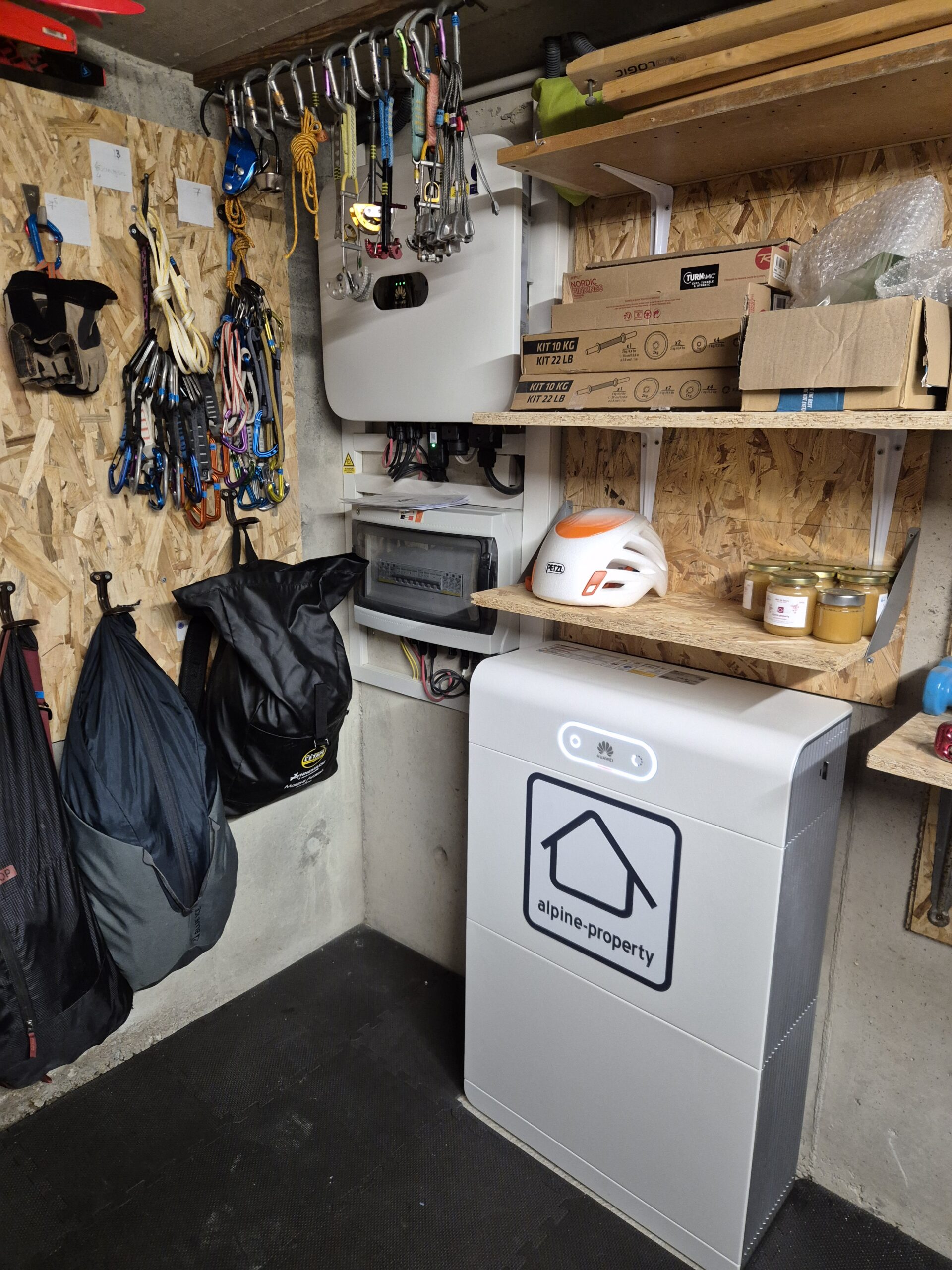
Inverter, battery and fuse board – in the corner of my garage cellar
The costs were 7,000€ for the panels and inverter, and another 7,000€ for the battery, 14,000€ in total. Against a projected annual saving of around 1,300€ (from 3,888€ down to around 2,000€), that’s a simple payback of 10 to 11 years. Remember, this is all my heating, cooking, working from home, and up to 5 people in the house. It includes 20,000 km a year of EV charging. That’s a lot of fuel not bought. At current French pump prices – around 2.03€/L for petrol and 2.20€/L for diesel – 20,000km in a typical SUV would cost somewhere between 3,000€ and 3,600€ in fuel alone. The same distance in the EV costs around 500€ in electricity, and from May to September, with the solar doing its job, it costs close to nothing.
A 10 year payback might sound like a long time, but this equates to an ROI of 10%. You won’t get that in your savings account, in the stock market, or even from property investment. Of course the upside is that with those other investments you can withdraw your money, but if you decide to sell your house you are likely to leave the kit behind. However, low running costs definitely add to the saleability of a property, so I don’t think it is money lost.
What Size Battery Do You Need?
This is a tricky question. The internet will tell you to size a battery to your maximum daily energy use, but I don’t think that works in an Alpine context. Our winter consumption can be extreme: heating, drying kit, short days. If you sized a battery to cover all of that, the cost would be enormous.
A better way to think about it: what do you actually want the battery to do? In summer, even a modest battery will get you through the night on solar alone. In winter, it’s mainly doing arbitrage, and for that a 14 kWh battery is more than adequate. And I am doing this to save money, not for vanity.
The good news is that battery prices have fallen dramatically, roughly five to ten times cheaper per kWh over the past decade, and they continue to fall. So if you’re on the fence about size, buying a system designed to accept a larger battery later is a reasonable approach. They are modular. If the prices fall further, making additional investment worthwhile, I will just buy another “brick” and stack it on what I have.
Three Phase vs Single Phase: Should You Convert?
Many houses in France, particularly ones around here, are on a 3-phase supply. Should you convert to single phase to make the solar install simpler? It’s not easy to answer, so talk to your installer. There are pros and cons either way depending on your specific setup. What I’d say is don’t let it put you off. It can be dealt with; my system handles all three phases, but it needs thinking about from the start, not as an afterthought. I touched on this in the original post; it’s even more relevant now with a battery in the mix.
The Power Cut Problem
Here’s something that surprises people: with a standard grid-tied solar and battery system, you cannot run your house during a power cut. Counterintuitive, I know. You have panels on the roof and a battery in the cellar, and none of it works when the grid goes down. The reason is safety: the system shuts itself off so it doesn’t back-feed the grid while engineers are working on it.
You can get around this with additional equipment, but it costs significantly more. My view is that for most people in the Alps, it isn’t worth it. Our power reliability is genuinely good here. It’s a real consideration if you’re somewhere more remote, but for most of us it’s a theoretical problem rather than a practical one.
Should You Wait for a V2G Electric Car?
Vehicle-to-grid (V2G) technology, where your electric car acts as a large battery for your house, is finally arriving properly. Renault has led the way, with both the Mégane E-Tech and Renault 5 now offering V2G capability. In principle, a 40+ kWh car battery that you can discharge into your house in the evening is a compelling proposition. I mentioned this possibility back in 2018 and it’s good to see it finally becoming real.
Should you wait for it? That’s a question of opportunity cost. You could wait: for V2G, for cheaper batteries, for better panels, for whatever comes next. But while you wait, you’re paying full rate for your electricity. The savings I’m making now are real and they compound. Waiting for perfection has a cost.
My Advice
- Start with the battery in mind. An install that isn’t battery-ready costs more to upgrade later.
- Use a local installer with a real guarantee. I know where Leman Solar’s office is. That matters.
- Put the inverter somewhere accessible. The cellar has been perfect.
- Think about 3-phase early. If your house has a 3-phase supply, make sure your installer is across it from day one.
As ever, the EU solar calculator is a great starting point for running your own numbers.
And if you’re in the Haute-Savoie area and want to talk it through, feel free to get in touch. Or directly with Leman Solar at https://www.leman-solar.fr/


It’s fascinating how your early DIY balcony power station foreshadowed the current surge in popularity for these systems, especially as UK codes begin to catch up. The lesson about heat-related microinverter failure on an Alpine summer roof is a crucial takeaway.
Hello there
Thank you for the article. I enjoyed reading it.
I’m just completing a three phase installation here myself in Morzine. On reflection, I think that having three phases provides slightly more benefits than dis benefits and I totally agree that you have to design for three phase from day one, not as an afterthought.
I opted for three single phase string inverters and recycled four old plug and play panels (failed micro inverters just like yours). I added 14 new panels but kept the old four panels on their own dedicated phase so as not to mix panel characteristics.
I have not yet bought a battery but instead, as you suggest, ensured that the system is battery ready (one of the inverters is hybrid ready to take a DC battery).
Instead of a battery I have installed a Myenergi Eddi (with Harvi). This automatically diverts any surplus to the hot water chauffe-eaus – it diverts to chauffe eau 1 until chauffe eau 1 is hot and then it flips to chauffe eau 2. So the hot water tanks effectively become a battery. Eddi costs €550 so I figured I would try this before investigating in a €5k (plus) chemical battery.
I have also installed an Eastron meter which connects to the three inverters. If Eastron detects any surplus (after Eddie has diverted everything it can) then Eastron automatically throttles the inverters so they are not injecting into the grid. Enerdis tolerate some leakage but with 18 panels on a sunny day I feared we may overstep their reasonability test. Eastron only cost €130 so I figured on the scale of things it made sense.
I am finalising the installation today (in the mid May snow!). The idea is to see how much surplus we generate after Eddi had heated all the water. This will help determine if a chemical battery makes sense.
But it probably does for the reasons you state; namely charging the battery with cheap HC electricity overnight and then using it to replace expensive HC electricity during the day. Something I hadn’t previously considered – thank you!
Next steps are writing and drawing it all up for the Consuel.
I’d enjoy keeping in touch and exchanging performance and technical information. Bonne courage!
Best regards
Very interesting to hear – the three single phase string does sound interesting and may well solve some of the issues. I might do a separate blog on my thoughts on the 3 phase thing. I wondered about going down the Harvi route, it would have made sense because I have a MyEnergi EV charger and an Eddi – but because of the configuration of the electrics in my house, I could not fit the required CT clamps! Plus we only have a 300l ballon, which takes about 12kw to heat up – and with 30kw of energy from the panels on a good day, that would not be enough. If you have two ballon – that could be a very cheap option. The arbitrage is a very good use of the battery in the winter. In the depths of January – my 14 kwh battery is empty by 11am!
Thanks for this thorough article Gareth – very helpful. I’m planning a solar installation and these are all of the considerations going around my head right now. Will be speaking with Chris at Leman Solar soon.
Go for it. There is a certain warm feeling to know you are producing your own power onsite.
Thanks for the post – super interesting, I had almost disregraded solar being useful for my little 50m2 apartment over 3 floors just above Biot. I do have lots of sloped garden space and a big section of roof for panels though. I wonder if you have any thoughts on the new plug and play style that companies like the jackery solarvault-3-pro-max are pushing? Our place is only 2 adults and a 150/200l water tank. I’d think the payback maybe quicker for a small host in this case?
Thanks
Alex
Alex, if you live there, my guess is the payback would be quite OK (you’d have to do the figures!), the great thing about the power stations like the one you mention is, you can take them to you next place easily, AND they provide decent backup in the event of a power cut – the downside is the warranty – probably only 3 years? And they do break. I had a Bluetti that broke – out of warranty. They offered me a discounted replacement – but when you are having to replace stuff like this, it messes up the ROI somewhat.
I think they are saying 10years – you’re right that was the first bit of info I looked for too. Thanks I’ll crunch some numbers